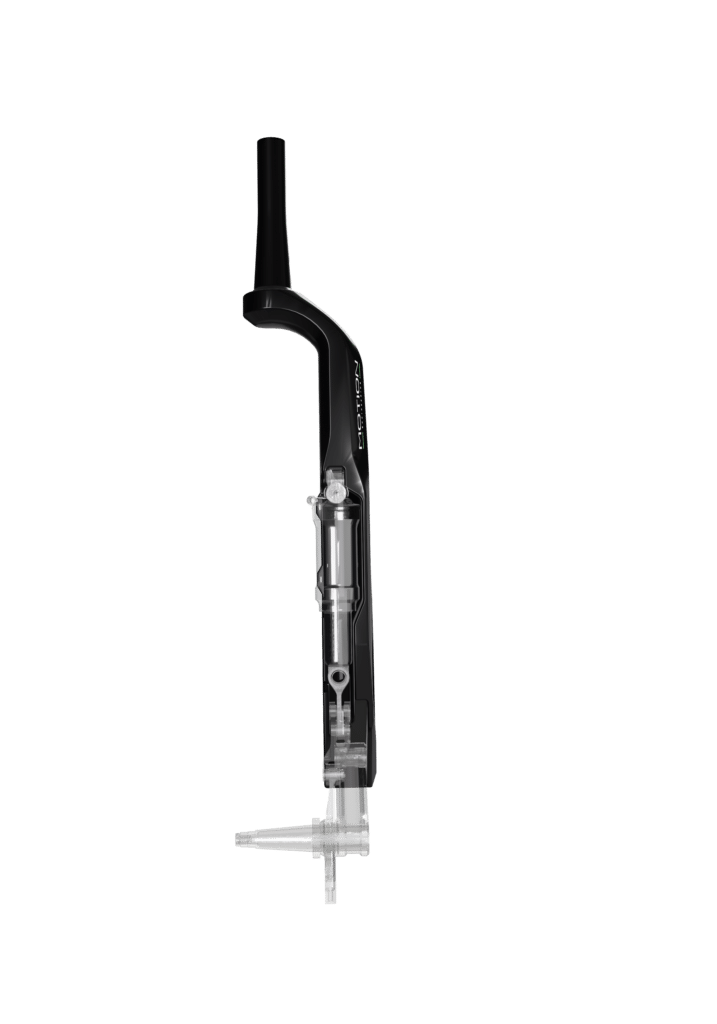
The telescopic design fundamentally limits the stiffness-to-weight ratio.
It is impossible to build a telescopic fork that is both perfectly precise and exceptionally lightweight.
Brake dive compromises both stability and bump absorption.
Under hard braking, a telescopic fork can lose up to 80% of its available travel, resulting in a significant loss of suspension performance when it is needed most.
High unsprung mass limits suspension sensitivity and bump absorption.
The lowers, spring, and damping system are all unsprung, accounting for up to 65% of the total weight of a telescopic fork.
The fork arch restricts mud clearance.
It also limits maximum tire and wheel size, forcing a compromise between weight, stiffness, and packaging.
The telescopic design causes a significant loss of grip and comfort under load.
Braking, impacts, and cornering forces generate friction within the system, reducing suspension sensitivity and forcing a compromise between performance and durability.
Wheel kinematics are fixed, leaving no room for performance optimization.
A telescopic fork is constrained to a straight wheel path with a constant 1:1 leverage ratio, severely limiting suspension tuning and dynamic performance.
A telescopic fork is constrained to a straight wheel path with a constant 1:1 leverage ratio, severely limiting suspension tuning and dynamic performance.